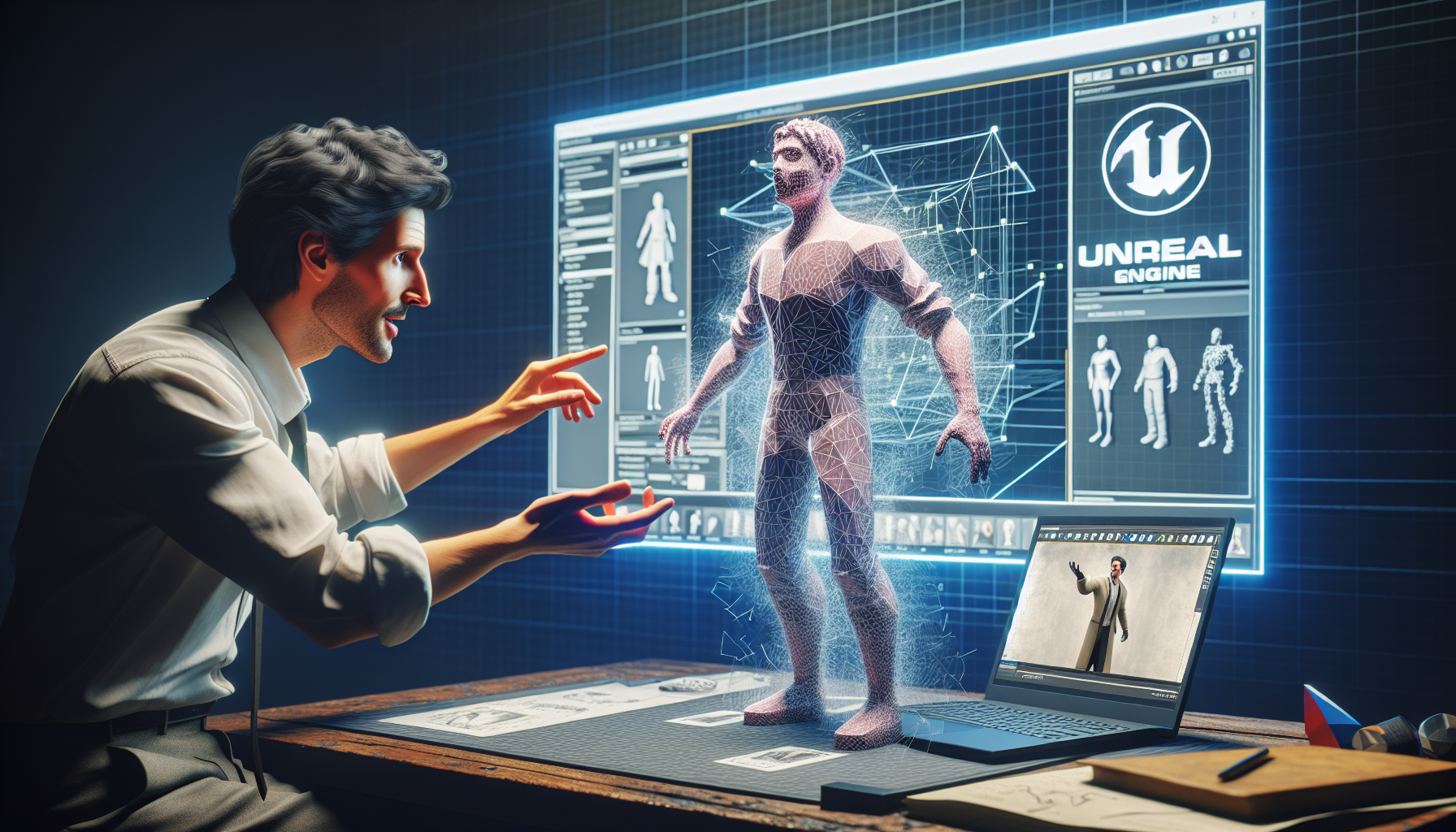
In the labyrinth of game development, where every polygon counts and every pixel is a battlefield, emerges a hero not from the shadows, but from the very substance of the digital world itself. Meet Nanite, Unreal Engine’s revolutionary virtualized geometry system. It’s not just a feature; it’s a paradigm shift, promising to arm developers with the might of millions of polygons without the computational overhead that usually sends hardware whimpering into a corner. Let’s dive deep into the heart of Nanite, where the magic of next-generation graphics comes to life.
What is Nanite?
Imagine if every grain of sand on a beach could be rendered in exquisite detail without tanking your framerate or setting your console on fire. That’s the dream, right? Nanite makes it a reality. It’s Unreal Engine’s micro superhero, designed to process and render incredibly high-detail visual assets efficiently. Nanite allows for cinematic-quality visual assets in games and simulations, composed of hundreds of millions or even billions of polygons, all processed in real-time. It’s like giving a telescope to every player, allowing them to see the universe in a grain of sand—literally.
How Does Nanite Work?
Nanite operates on a principle that feels almost like it’s breaking the laws of computing physics. Here’s a simplified breakdown:
- Virtualization of Geometry: At its core, Nanite uses what’s called “virtualized geometry.” This means it only processes and renders the details you can actually see in a scene—nothing more, nothing less. It intelligently streams and scales polygonal detail based on what the camera views.
- Cluster Culling: Nanite clusters geometry into hierarchical groups and then decides, in real-time, which clusters need to be rendered based on their importance and visibility to the camera’s perspective. It’s like having an incredibly efficient librarian who knows exactly which books you need from a library of billions.
- Efficiency at Scale: By focusing only on visible details, Nanite drastically reduces the strain on hardware resources, allowing for unprecedented levels of detail without traditional performance hits. It’s akin to packing the contents of an entire mansion into a small, neat suitcase.
The Benefits of Using Nanite
1. Unprecedented Detail: With Nanite, developers can create and import assets of almost any complexity without worrying about traditional polygon budget limitations. It’s a free pass to up the detail ante.
2. Streamlined Workflow: Forget about painstaking LOD (Level of Detail) model creation. Nanite handles scaling details dynamically, which can simplify content creation pipelines significantly.
3. Real-Time Rendering: The magic of Nanite isn’t just in the details—it’s in delivering these details in real time. This is crucial not just for immersive gaming but also for fields like virtual production and architectural visualization.
4. Opens Creative Doors: With the ability to handle vast geometric complexity, artists and developers can push the boundaries of creativity. More detailed environments, richer scenes, and more complex objects become not just possible, but easy to manage.
Getting Started with Nanite
Activate Nanite in Your Project: To dive into using Nanite, start by enabling it for your meshes in Unreal Engine. This involves importing your assets and ticking the Nanite option in the import settings.
Optimize Assets for Nanite: While Nanite is powerful, it works best with meshes optimized for its system. This means clean, well-constructed geometry that can take full advantage of Nanite’s capabilities.
Test and Iterate: As with any new technology, the key to leveraging Nanite effectively lies in testing and iteration. See how your assets perform, adjust your approach, and continue to push the limits.
Conclusion: A New Era of Visual Fidelity
Nanite isn’t just another tool in the Unreal Engine shed—it’s a revolution in how we think about, create, and interact with digital environments. For developers and artists, Nanite offers a glimpse into the future of gaming and digital simulation—a world where the only limit to visual complexity is your imagination. So why settle for less when you can Nanite your way to a more detailed, efficient, and stunning virtual world? Welcome to the future of rendering; it’s looking quite detailed from here.